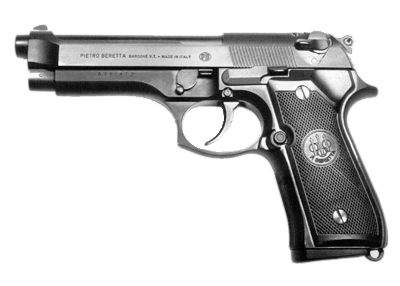
From the files of 'Things Have REALLY Gone Wrong If You Need To Use This On The Battlefield', I bring you the US military's current sidearm of choice, the M9.
As a 9mm pistol, the M9 is adequate but effective, and yes, I AM damning with faint praise, thank-you-very-much. It is a fairly complex weapon, with a lot of moving parts, that really likes to be clean and well-lubricated to fire reliably. Of course, this DOES make it a natural partner to the M16/M4...
At least the Coast Guard, of all folks, has moved on to a top-tier pistol (Sig Sauer P229DAK). The Marines, displaying their usual warfighting enlightenment, have more or less side-stepped the whole "Seriously, a pistol? On the battlefield?" question, by only issuing the M9 to Colonels and above. Everybody else that would have gotten a pistol, gets an M4. God bless the USMC.
To be fair, my primary beef with the M9 is that it is a 9mm (due to the whole NATO thing) that is limited to firing ball rounds (due to the Hague Conventions), and that severely limits it in terms of threat-stopping capability. That, and the fact that time has marched on in terms of pistol design (*cough*Glock*cough*), means that by modern standards, the M9 is overly complicated and finicky. However, the OTHER pistol that passed the evaluation and could have been chosen by the US military was the Sig Sauer P226, and THAT, my friends, is a true 'Cadillac' pistol (and I'm meaning Cadillac in a good way here...). Whether it was due to politics, the bean-counters, or both, the US military got screwed.
As such, most modern-day law-enforcement officers, who pretty much rely on pistols as their primary weapons, shudder at the idea of carrying a 92FS on the street. Whereas the P226 is carried with confidence by many (though with +P JHP rounds).
The Wikipedia Stuff!
The M9 pistol, formally Pistol, Semiautomatic, 9mm, M9, is a 9x19mm Parabellum pistol of the United States military adopted in the 1980s. It is basically a military specification Beretta 92F, later the 92FS.
It won a competition in the 1980s to replace the M1911A1 as the primary handgun of the U.S. military, beating out many other contenders. It officially entered service in 1990.[1] Some other models have been adopted to a lesser extent, namely the M11 pistol, and older, or different, models remain in use in certain niches. The M9 was scheduled to be replaced under an Army program, the Future Handgun System (FHS), which was merged with the SOF Combat Pistol program to create the Joint Combat Pistol (JCP). In early 2006, the JCP was renamed Combat Pistol (CP), and the number of pistols to be bought was drastically cut back.
History
In the 1970s, in an effort to make all five branches of U.S. Forces' weapons in sync, the Joint Services Small Arms Planning Commission was formed to test a variety of guns. The 92F survived exposure to temperatures from -40°F to 140°F, being soaked in salt water, being dropped repeatedly on concrete, and being buried in sand, mud, and snow. Additionally, the 92F proved a MRBF (mean rounds before failure) of 35,000 rounds. That number is equivalent to five or six times the pistol's service life.[2]
Technical description
A short recoil, semi-automatic, single-action / double-action pistol, the M9 uses a 15-round staggered magazine with a reversible magazine release button that can be positioned for either right or left-handed shooters. The M9 is used with the M12 Holster (Part of the Beretta UM84 Holster System), though other holsters are often used.
The M9 has been modified as the M9A1, adding, among other things, a Picatinny rail for the attachment of lights, lasers, and other accessories to the weapon. The M9A1 also has more aggressive front and backstrap checkering, a beveled magazine well for easier reloading of the weapon, and a reversible magazine release. M9A1 pistols are sold with PVD coated magazines developed to better withstand the conditions in the sandy environments in Iraq and Afghanistan.
Controversy

Prior to its widespread adoption by the U.S. military, questions were raised in a General Accounting Office report after an incident where a slide failure on a Beretta 92SB injured a Naval Special Warfare member[3] and two more failures were later observed in additional testing. These failures included both military and civilian Beretta models with very high round counts and after investigation they were deemed the result of ammunition supplied by the U.S. Army which exceeded the recommended pressures specified by NATO and by Beretta, but nonetheless provoked a modification in the M9 design to prevent slide failure from causing injuries.
Soldiers in the field also had a lot of concerns with the M9, notably a lack of confidence in its stopping power,[4] resulting from the use of the 9mm ball round, a significant factor in military evaluations because the Hague Conventions of 1899 and 1907 prohibit use of expanding or fragmenting bullets in warfare.
There were also a number of common mechanical defects, most notably problems with the magazine springs becoming too slack, which has been attributed to the fact that the M9 is a sidearm and as such is not reloaded for long periods of time, thus straining the springs.[5]

The U.S. military has been criticized for not purchasing magazines from Beretta. In 2006, the military awarded a contract to Airtronic USA due to the previous manufacturer, Check-Mate Industries, charging too much per magazine[6], though Check-Mate magazines are still sometimes issued. Prior to Check-Mate magazines being purchased, the military purchased magazines from the Italian firm Mec-Gar.[6] Airtronic has stated that its M9 magazines will be made similar to Mec-Gar's, due to Check-Mate magazines having reliability problems.[6]
In 2003–2004 there were reported failures with the government contracted 9mm magazines. After extensive testing and actual testimony given by the troops it was concluded that the failures were due to the heavy phosphate finish called for in the government contract, combined with the unique environmental conditions in Iraq. After corrections to the government required specifications for the magazine finish, almost two million new magazines have been distributed without any further malfunctions.
In the competition to find a new vendor, three finalists were chosen. These three were: Airtronic Services, Inc. classified as a "Moderate Risk", PHT Supply (partnered with Triple K Mfg.) also classified as a "Moderate Risk" and Check-Mate Industries, Inc. classified as a "Very Low Risk". Of the three, Airtronic Services, Inc was chosen due to their low bid of "$22,471,600" (Source: GAO). Airtronic Services delivered the first 900,000 magazines with zero failures, while costing less than the previous supplier Check-Mate Industries (source GAO and US Court of Federal Small Claims).
Users
The M9 is the standard pistol of the U.S. Army and Air Force Security Forces, and the M9A1 is the standard pistol of the U.S. Marines.[7] A large number of M9s and M9A1s was ordered in 2006. During the 2009 SHOT Show, Beretta announced it had received a US$220 million contract for the delivery of 450,000 M9s and M9A1s to the U.S. military, within a five-year span.[8]
The Marine Corps Times reported plans in July 2007 for all officers below the rank of Colonel and all NCOs to be issued the M4 carbine instead of the M9. The new assignment policy will still assign M9s to Marine Colonels and above and Navy Petty Officer First Class and above.[9]
The U.S. Coast Guard has replaced most of its M9s with the SIG P229 DAK. Some M9s still remain in service in reserve units.

No comments:
Post a Comment